
Anson County Sex Offender Checks
The North Carolina Sex Offender and Public Protection Registry is the main public channel for Anson County. The North Carolina State Bureau of Investigation manages the website with information entered by county sheriffs. Searchers can look near an address, use a name with a city or ZIP code, enter map coordinates, or use a Sex Registration Number. Each path answers a different question. An address search is useful for community awareness, while an identifier is more precise when it is already known.
The Anson County Sheriff supplies and checks county registration data. Call 704-694-4188 or contact the office at 119 N. Washington St., Wadesboro, when a public entry appears stale, an address seems wrong, or possible nonregistration needs review. The sheriff, not a private search service, can check the source data. For records beyond North Carolina, the National Sex Offender Public Website provides the official cross-state layer.
Access flow: SBI use policy › registry search › profile comparison › Anson County Sheriff follow-up.
Anson County Registry Use Policy
A first visit to the direct search sends the user to the SBI Acceptable Use Policy. That screen explains that Anson County registry information is published for public protection, awareness, and proactive safety steps. The user must accept those terms before reaching the search form. Threats, stalking, intimidation, harassment, or another crime based on registry data may be prosecuted.
The official registry landing route sends a new user through that required gate before any Anson County sex offender search.
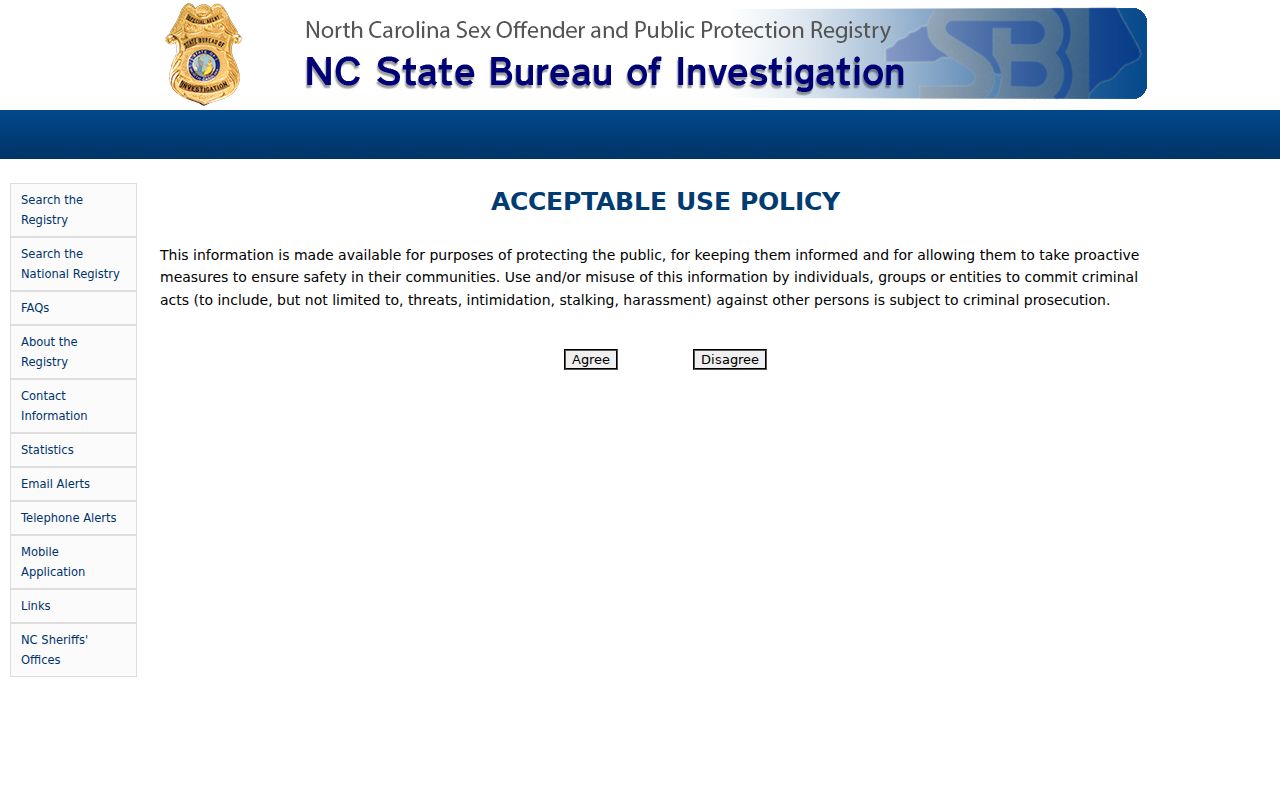
This gate is part of the public system, not an optional warning added after results appear. Accept it only when the planned use fits lawful safety and awareness purposes.
North Carolina Sex Offender and Public Protection Registry Searches
The registry combines several search modes instead of one county-only list. Start with the mode that fits the facts at hand, and avoid treating a broad result as a confirmed match. SBI says only fingerprint comparison can positively identify a person. Names, photos, physical traits, addresses, offenses, and status can help distinguish entries, but none alone replaces fingerprints.
- Open the official registry and read the acceptable-use terms before agreeing to them.
- Choose an address, name with city or ZIP, coordinates, or registration-number search.
- Review several public profile fields. Do not rely on a shared name or one similar trait.
- Send a suspected Anson County error or nonregistration concern to the sheriff with clear details.
The official SBI registry search interface presents these routes after policy acceptance.
The blank form lets a user select a suitable search route without displaying or republishing any private person's result.
| Field or mode | Type | Required | Use |
|---|---|---|---|
| Offenders nearby your address | Mode | Unspecified | Find public entries near a North Carolina address. |
| Address | Text | Unspecified | Supplies the point for proximity searching. |
| Name | Text | Unspecified | May be combined with city or ZIP. |
| City or ZIP | Text or selection | Unspecified | Narrows a geographic name search. |
| Latitude and longitude | Numeric text | Unspecified | Supports a coordinate-based search. |
| Sex Registration Number | Text | Unspecified | Uses a known registry identifier. |
Exact required flags and button labels were not verified before policy acceptance, so they should be read from the live form rather than assumed.
Anson County Registry Address Alerts
SBI offers an email alert channel for people who want notice tied to a place rather than repeated manual Anson County registry searches. The official FAQ says a subscriber may register more than one North Carolina address and choose a one-, three-, or five-mile radius. That can serve a home, a relative's home, or another place connected to personal and family safety. The radius describes the alert area, not a legal residency boundary.
The official registry email-alert signup is separate from the public profile search.
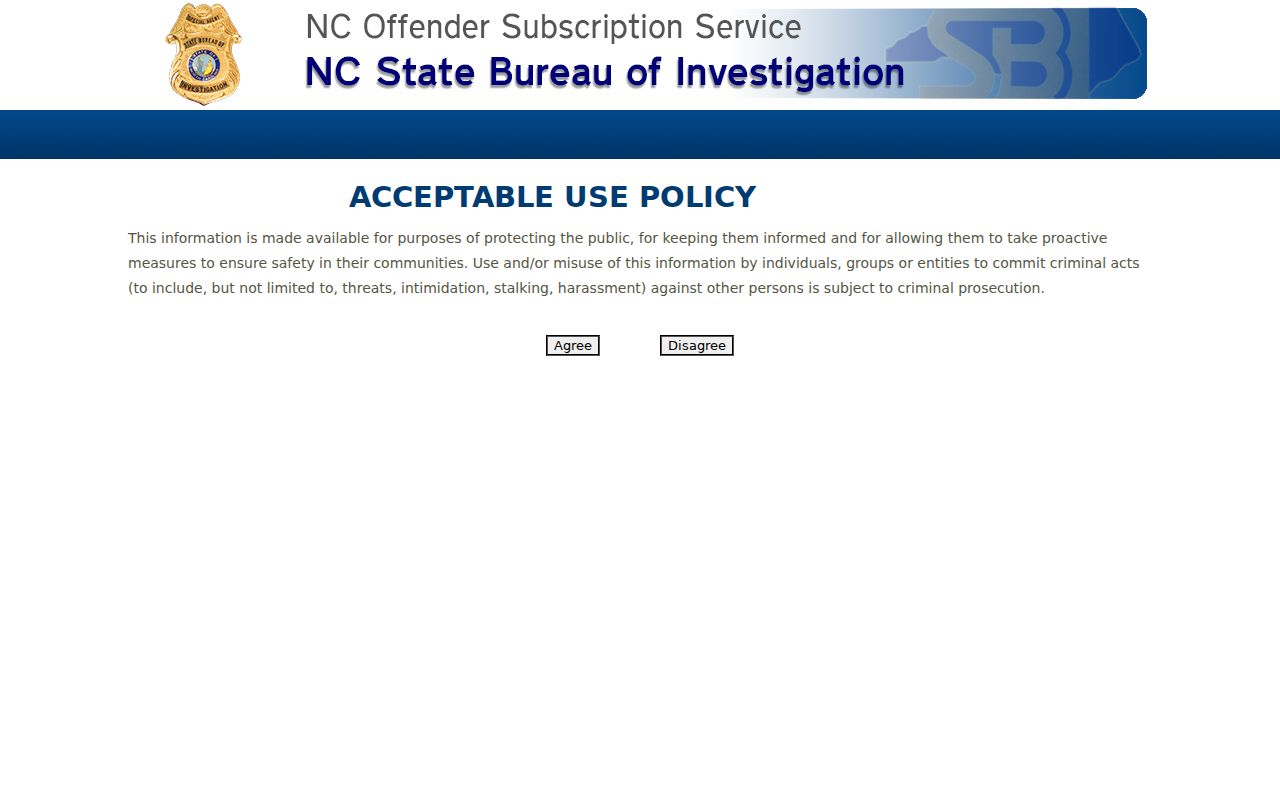
The signup screen gives Anson County residents a way to monitor chosen locations while keeping the search and alert functions distinct.
Telephone and status notices are also available through NC SAVAN and VINELink. Those notices can supplement registry review, but they should not be read as proof that every change will arrive at once. Sheriff-entered data may face processing delays.
Registry Profiles: What They Show
North Carolina's official registration guide identifies the public county-registry fields. An Anson County sex offender profile may show the person's name, sex, address, physical description, picture, conviction date, offense requiring registration, sentence imposed, and registration status. The profile is a defined public record, not a full police report, court file, or life history.
| Name | The name reported in the county registry record; compare other facts before deciding it is a match. |
|---|---|
| Picture and description | A public photograph and physical traits used to help distinguish people. |
| Registered address | The address entered through the sheriff's registration process, subject to change and reporting time. |
| Conviction and offense | The conviction date and offense that created the registration duty. |
| Sentence imposed | The sentence tied to the registry-qualifying conviction. |
| Registration status | The status shown in the official registry, which should be checked against current source data. |
Victim identities, treatment records, medical records, and juvenile registry material are not ordinary public profile fields. SBI also warns that some details are self-reported and can change fast. A missing fact does not prove that no event occurred.
Note: Juvenile delinquency adjudications are excluded from the public registry, so an adult-profile search cannot answer every juvenile-record question.
Anson County Registry Count Limits
The official county registry statistics showed 59 for Anson County when inspected on August 1, 2026.
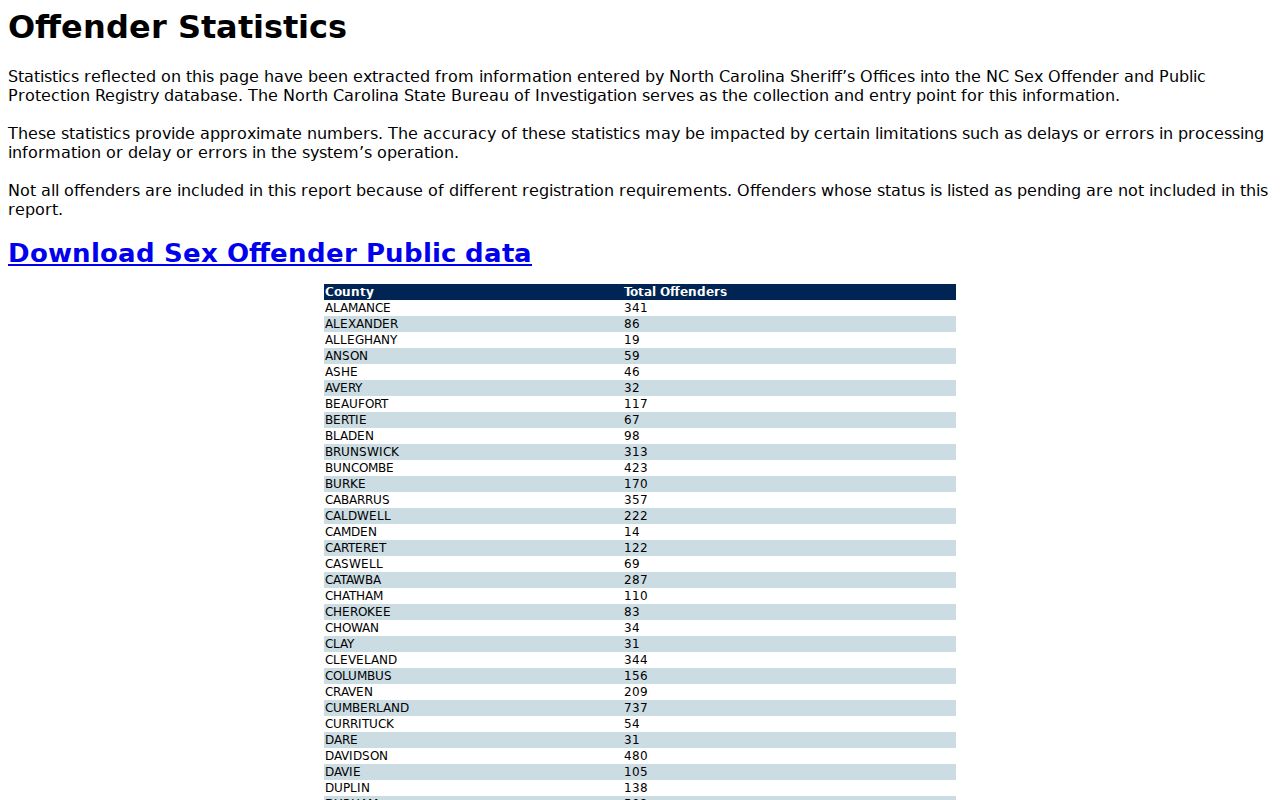
The displayed Anson County total is a useful point-in-time count, but the state labels county figures as approximate rather than exact.
Sheriff-entered records may be delayed by processing, system issues, or errors. Pending records and some people governed by different rules may also be excluded. The figure therefore should not be used to predict how many results a street, ZIP, or radius search will return. Run the live registry search for current public entries and ask the Anson County Sheriff about a suspected gap.
Registration Levels and Duties in North Carolina
North Carolina does not label its state registration classes as a simple federal Tier I, II, and III ladder. Article 27A instead distinguishes regular Part 2 registrants from aggravated offenders, recidivists, and sexually violent predators. Separate rules cover juvenile registration and satellite monitoring. Using the federal tier names for an Anson County profile can therefore misstate the state record.
| North Carolina class | Duration | Verification or relief |
|---|---|---|
| Regular Part 2 registrant | Not automatically ended at ten years | Covered registrants verify every six months; an eligible person may petition Superior Court after ten years from initial county registration. |
| Aggravated offender | More stringent lifetime regime | Subject to the enhanced requirements set by Article 27A. |
| Recidivist | More stringent lifetime regime | Subject to the enhanced requirements set by Article 27A. |
| Sexually violent predator | More stringent lifetime regime | Subject to the enhanced requirements set by Article 27A. |
A petition under G.S. 14-208.12A is a request for Superior Court review, not automatic removal. Failure to register, report an address change, return verification, or give truthful required facts is a Class F felony. Current status should always come from the live registry and the Anson County Sheriff.
Anson County Registry Residence Rule
The SBI registration guide's summary of G.S. 14-208.16 describes a 1,000-foot residence restriction for covered registrants. The measurement runs from school or child-care-center property lines, and violation is a Class G felony. That rule should not be broadened into an unsupported claim that every park or public site creates the same boundary.
For an Anson County address question, the registry map can supply geographic context, but the sheriff is the sound source for registration compliance. Property lines and the person's legal classification matter. A map pin or straight-line guess does not resolve every statutory issue. Report facts to the office and avoid direct contact with the person shown.
Anson County Registry Across States
The SBI registry gives the deepest official view of North Carolina data, while the U.S. Department of Justice's NSOPW routes a search across participating jurisdictions. Use NSOPW when a person may have lived beyond Anson County or when family safety planning spans state lines. Return to the source jurisdiction for profile detail and corrections because the national layer does not turn each state system into one uniform record.
The official national registry search interface is the government source for that broader check.
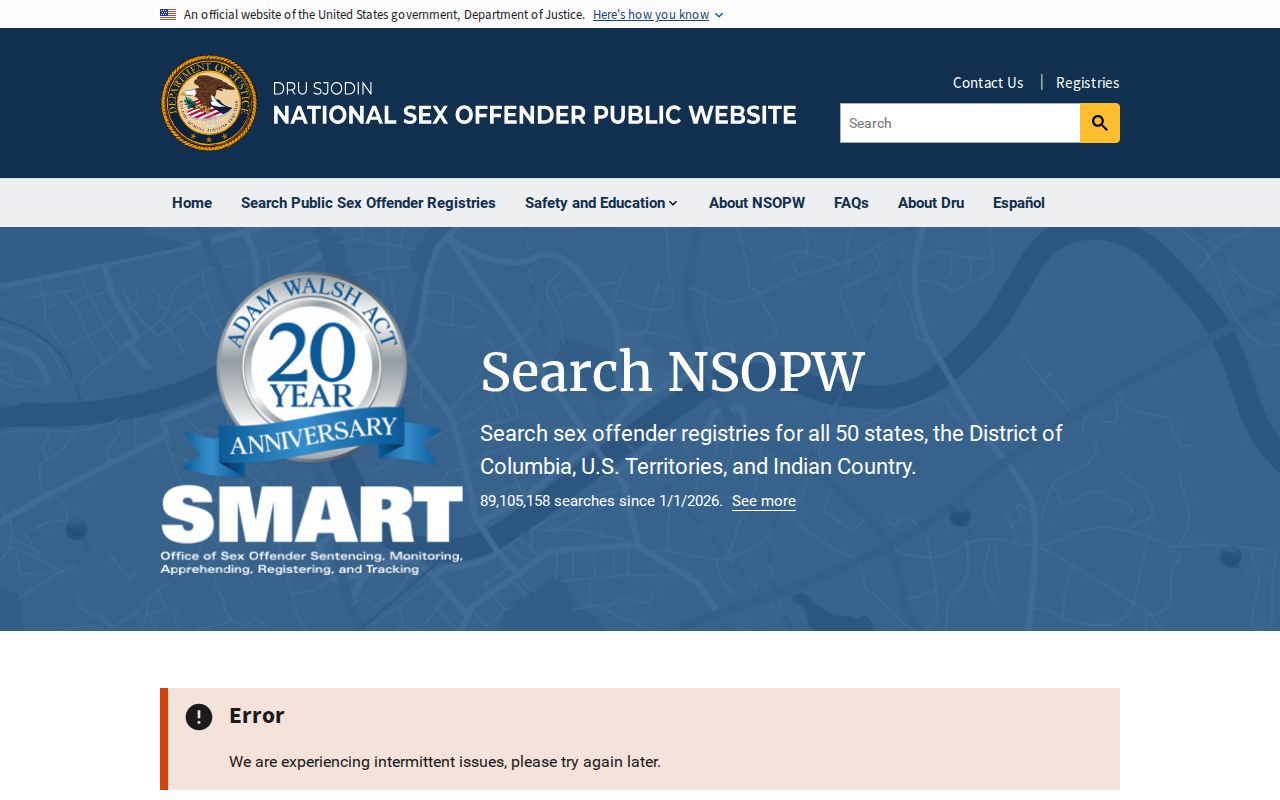
This cross-state search complements the North Carolina registry. It does not replace an Anson County sheriff review when a local address or status appears wrong.
Using Registry Information Lawfully
Anson County registry records are published for awareness and community safety. Read the whole profile, account for the state's warnings, and use official alert tools for calm planning. Do not confront a registrant. If an address, status, or required entry seems wrong, collect the specific public details and report them to the Anson County Sheriff at 704-694-4188. The sheriff can compare county registration material with the state entry.
Misuse is a crime: The SBI warns that threats, intimidation, stalking, harassment, or other crimes committed with registry information may be prosecuted under North Carolina law.
The public registry has limits. It excludes juvenile registry data, cannot show unknown conduct, and may contain self-reported facts or processing delays. A search result supports awareness, not a claim about conduct beyond what the official profile states.